Office hours: Mon - Fri 09:00 - 17:30 (Sat closed during Nov/Dec 2026)
Office hours: Mon - Fri 09:00 - 17:30 (Sat closed during Nov/Dec 2026)
Office hours: East Coast USA: Mon - Fri 09:00 - 17:30 (04:00 - 12:30 local time) (Sat closed during Nov/Dec 2026)
West Coast USA: Mon - Fri 09:00 -17:30 (01:00 - 09:30 local time); Sat 09:30 - 13:00 (01:30 - 05:00)
Office hours: Ottawa: Mon - Fri 09:00 - 17:30 (04:00 - 12:30 local time) (Sat closed during Nov/Dec 2026)
Vancouver: Mon - Fri 09:00 - 17:30 (01:00 - 09:30 local time); Sat 09:30 - 13:00 (01:30 - 05:00)
Office hours: Canberra: Mon - Fri 09:00 - 17:30 (20:00 - 04:30 local time) (Sat closed during Nov/Dec 2026)
Office hours: Mon - Fri 09:00 - 17:30 (22:00 - 06:30 local time) (Sat closed during Nov/Dec 2026)
Office hours: Mon - Fri 09:00 - 17:30 (check internet for local time equivalent) (Sat closed during Nov/Dec 2026)
Festive traditions around Europe
Celebrating around Europe
We’ve been chatting with some of our local contacts around Europe to find out about Christmas tradition around Europe.
 The Twelve Grapes of Luck
Aznar (our local contact in northern Spain) tells us of a Spanish tradition for New Year: On 31st December people join together to celebrate the end of one year and start of the next. When the clock of the Puerta del Sol in Madrid rings out at midnight, people at home eat one grape for each strike of the bells and wish for a year of luck and prosperity, followed by a toast with champagne or cava. It’s a tradition dating to the late 19th century, and popularised by grape growers following a bumper harvest in 1909!
Gifts are traditionally given at Epiphany on 6th January, but the appearance of “Papa Noel” on 24th or 25th December has become common. In the Basque region it is often “Olentzero” who brings the gifts. There are many legends around this ancient character, who may have been a giant, or a charcoal burner or an old blind man, and is often recreated in the clothing of a Basque farmer. The one element of the Olentzero story that is common to celebrations in many cultures is the giving of presents and consumption of lots of good food.
The Sibil-la concert in Mallorca
Our local contact in Mallorca, Jesca, tells us about one of the most beautiful traditions on the island:
“On 24th December many attend the Midnight Mass, which includes the ‘Sibil·la concert’, a tradition dating to the 10th century and brought to Mallorca by King Jaime I the “Conquistador” in the 13th century. It is a magical moment where the arrival of the ‘Final Judgement’ is announced: in Palma’s cathedral (La Seu) and in every church on the island a child dressed in medieval clothes carrying a sword recites a song. So ancient is the song, which has a Gregorian melody and is sung without instrumental accompaniment, that in 2010 it was declared an Intangible Cultural Heritage of Humanity by UNESCO. Afterwards, it is a must to go with your family and enjoy a cup of steaming hot chocolate with an ensaïmada, a traditional Mallorquin pastry – equally delicious at the end of a winter hike along On Foot’s Mallorca hiking trail!”
Get a sneak preview in the video below from an earlier Christmas Eve in Palma cathedral.
A modern tradition in Slovenia
As in many places around the world, Christmas traditions in Slovenia are focused on religious ceremonies, spending time with family, and lots of food and drink. Miha (our man in Slovenia) says that Potica makes any celebration special – this delicious treat is baked in a ring-shaped mould and filled with something tasty such as walnut, hazelnut, chocolate, or even tarragon. Here’s the recipe – why not give it a try?!
At Postojna, very close to the start of our Slovenian walking route, a modern tradition has developed in the last 30 years. Visitors to the cave can walk the 5km path through ‘The Living Nativity‘, an illuminated wonderland in the magnificent cave complex, with scenes from the nativity story depicted along the way. 150 local people join professional musicians to enact the story. There’s stiff competition for the roles of the angels.
St Nikolaus spotted near the Rhine!
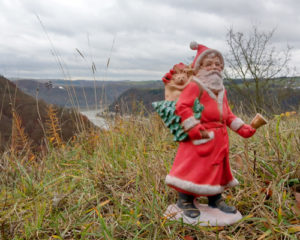 One of the favourite places of Bea, who looks after our walkers in Germany, is the section of On Foot’s Castles of the Rhine holiday between St Goarshausen and Kamp-Bornhofen. She recently spotted St Nikolaus there, and also told us how families will be celebrating at home this year.
“On Christmas Eve families come together to wait for the Christkind (a girl with long hair who is, crucially, invisible), while eating Weihnachtsstollen and Weihnachtsplätzchen. The room with the Christmas tree is locked and when it gets dark, suddenly you can hear a bell ring – the sign that the Christkind has passed. Everyone rushes into the room where the tree is decorated with balls and lighted candles. Under the tree are many, many presents, but before opening them we sing Christmas carols like “Stille Nacht, Heilige Nacht” and we are listening to the Christmas Story. Christmas is very traditional in Germany. We usually go to mass at midnight and celebrate Christmas with our family.”
Nociata – a sweet treat from Umbria
Elisabeth has sent us this recipe from her home in the Umbrian hills. It’s a walnut honey brittle which is eaten by peeling back the bay leaves slightly, allowing their aroma to mingle with the sweetness of the walnuts. Afterwards, the leaves are thrown in the fire for a tiny firework display.
Nociata (50 pieces)
2/3 cup honey
225g finely chopped walnuts
100 fresh bay leaves
Put the honey in a pan over medium heat and cook until it’s very runny. Stir in the walnuts and cook until the walnuts are toasted, the honey begins to caramelize and the mixture pulls away from the sides of the pan, 8 to 10 minutes. Keep on stirring the whole time!
Lightly dampen a baking sheet with water and pour the walnut mixture onto it. Dampen a spatula with water and spread the mixture out. Lightly push down on the mixture to flatten it evenly into a rectangle, 0.5 cm thick.
With a sharp knife, cut into diamonds (4 cm long x 2 cm wide). Using the offset spatula, lift up one of the diamonds and put it on the inner side of a bay leaf, so the points of the diamond are facing the points of the leaf. Top with the inner side of another bay leaf and press the leaves together to adhere to the walnut brittle. Continue with the remaining pieces.
Refrigerate for at least 8 hours and up to overnight. These keep well in the fridge, but rarely last long in our house.
Wherever you are, and however you celebrate at this time of year, we wish you joy, peace and health. Keep walking!
From all of us at On Foot Holidays
Mike and Judy Patrick walked the Lighthouse Way in Galicia, and spent some time in A Coruña before returning home. Mike was looking at the town through architect’s eyes, and sent his impressions – a reminder to us all to look up from street level more often!
 A Coruña is ‘My Kind of Town’. It is a bit off the beaten track and not an obvious tourist destination – but all the better for that. Built on a thin-necked promontory projecting out into the Atlantic, it is the commercial hub of what is otherwise one of the poorest regions of Spain. The rural economy has been in decline for years due to lack of employment opportunities.
A Coruña is not without history; there is a significant iron age settlement on the outskirts and the oldest part of town is built on the site of a Celtic hill fort. There was a Roman settlement here on the outer perimeter of empire and some of you will be familiar with Sir John Moore’s retreat to Coruña at the outset of the Peninsular War, an example, like Dunkirk, of a disastrous British military defeat turned into victory by the British propaganda machine.
One side of the ‘neck’ looks across to an industrial hinterland and comprises a harbour, where the occasional gigantic liner may still be glimpsed for a day before she ventures out across a windy Bay of Biscay. (The sister ship of the doomed Costa Concordia was in town while we were there.)
The other side of the neck consists of a sweeping bay of white sand, providing no less than five city beaches of various sizes. Late September had an end-of-season feel but there were still a few oldies basking like beached seals. There was one sleek, tanned individual in his 70’s, sporting bright orange shorts and a peaked cap, performing a passable La Liga solo training session with a white football.
 The neck itself – perhaps half a mile across – comprises the commercial heart of the town, with some imposing mid-rise 19th century buildings, with fin de siecle Art Nouveau details, testament to trading prosperity. Threading along this part of town is a sequence of pedestrian alleys, teeming at night with busy bars and restaurants. Enjoy a tapas or seafood with a glass of Albarino.
Beyond the commercial centre lies the old town and on the headland stands A Coruña’s symbol, the Torre de Hercules, a substantial stone-built lighthouse, dating from Roman times, robustly re-clad in the 18th century, and still providing protection to the local seaway. The town boasts a fine 1950’s concrete shell fish market, and an outstanding Museo de Bellas Artes designed by Manuel Gallego Jorreto. (No, I hadn’t heard of him either, but it’s a quality building and houses a fine collection of Goya prints.)
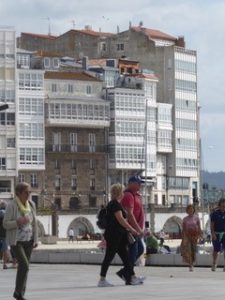
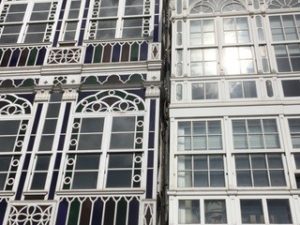
Throughout Galicia, you will see town houses with upper story projecting galleries – enclosed winter gardens ideally suited to a climate of summer heat and wet and windy winter weather. A Coruña has many examples of this vernacular, which reaches its apotheosis in the city square Maria Pita and above all, along the Avienda de la Marina, where gleaming white-framed galleried facades extend full height above a ground floor arched stone plinth. Here you can enjoy a coffee and watch the well-heeled and elegantly dressed locals pass to and fro.
See more about walking the Lighthouse Way
Lots more walking holidays in Spain
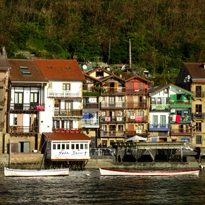
The well-kept villages of Spain’s western Pyrenees are the true centre of Basque culture, protected by the mountains from incursion. This is a border zone where French influences are also strong, but foremost is an outgoing friendliness resulting from the pride of being born Basque.
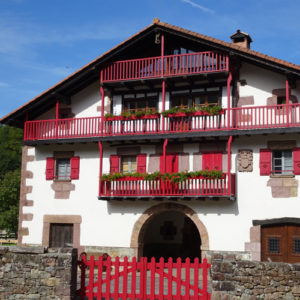
Our self-guided walk begins inland, exploring unspoilt farming country and some extraordinary village architecture, as well as climbing Mount Alba. Walking northwest, you’ll pop over the border into France briefly, before reaching the sea and taking a small boat across the water to Hondarribia, a town with an incomparable old walled centre. Then, for the hardy, a spectacular ridge walk along the coast to San Sebastian, laid out around two sandy bays below our cliff-top approach. This European City of Culture (2016) is well worth a visit, and makes a triumphant climax to the holiday.
The full 8-night version of this walk is a challenge, with great rewards. There are plenty of options, however, to either take an easier route or to ride with the luggage part of the way. Or look at the 7, 6 and 5-night versions if you are pressed for time. All include stays in some beautifully restored Basque village houses, and there are grander upgrade options for a little luxury.

On Foot Holidays’ route in the wild hills of the Basque Pyrenees is one of our most popular, and gets some great feedback:
“We loved the peace and quiet. I loved having conversations with the locals and hearing their stories. One of my favorite experiences was our encounter with the horses. We were able to get quite close to some. I also truly enjoyed the day we hiked the French side of the Pyrenees. The vistas were out of this world. And hiking the ridge to San Sebastian was awesome.”
“The options to vary walks were great. Aznar was outstanding! He communicated with us regularly, his advice and suggestions on things to see, do and experience, and places to eat was fantastic. Undoubtedly the best we have ever had – and we’ve done several self-guided holidays.”
Andrew Morris sent us some video clips, and you can also read an account of his walk on the Silver Travel Advisor website.
See more about the Basque Pyrenees here, or call us to speak to Simon or Mary who have both walked the route.